The one who prays must wholeheartedly concentrate on the meaning of the words which he utters with his lips. He must imagine that he stands in the presence of God. He should remove all other thoughts [from his mind], until his consciousness and concentration are completely absorbed with his prayer. He must imagine that if he were speaking before an earthly king, he would carefully compose his words and concentrate on them so as not to falter, all the more so [when speaking] before the King of all kings, the "Holy One, blessed be He", who sees to the very heart of all thoughts. This was the practice of the early pious people and men of good deeds. They would meditate in solitude and concentrate on their prayers until they achieved a transcendent spiritual state wherein their soul overpowered their body, thus approaching a state of prophecy...How do you teach this to kids? Again, I find it interesting that meditation is a key word that is appearing in tefilla tips from Rabbis of every generation, but I am not hearing this word (nor concept) reverberating much amongst contemporary educators.
Showing posts with label Shulchan Aruch. Show all posts
Showing posts with label Shulchan Aruch. Show all posts
Tuesday, January 1, 2013
Praying with a Whole Heart and a Clear Mind
Rav Yosef Karo, one of my favorite people from Toledo (Spain), wrote in the Shulchan Aruch, Orach Cha’yim
(98:1) the following:

Tuesday, November 1, 2011
Davening Like a Lion
To those who know me know that I am very upfront about the limitations of my learning background and gaps in my education. My unorthodox upbringing has allowed me to appreciate much my journey in the Jewish world as well as my academic explorations. My introduction to serious Jewish text had an instant impact on my life and I'd like to share an inspiring revelation with you all.
The Shulchan Aruch, the codification of traditional Jewish law by Rabbi Yosef Caro in 1563, is a significant primary text. Especially when it is combined with Rabbi Moshe Isserles' gloss presenting Ashkenazi interpretations. The fact that THE book of Jewish customs starts with diverging interpretations was one of the first beautiful encounters in my studies (this point reinforces a valuable lesson in diversity). But, I digress. The very first law taught in the Shulchan Aruch is the following:
 The above presents an interpretative challenge as it is possible - at a quick glance- to miss the essence of the sentence (or as Chaim Nachman Bialik said, "Reading in translation is like kissing through a veil"). One way to restate this law is: "Arise in the morning like a lion to serve The Creator". I remember being struck by this command to become a morning person - to jump out of bed to run to do mitzvot. I was/am not an early riser and this was a philosophical struggle to grasp the essence of this behavior.
Upon visiting the zoo, I soon learned that lions sleep or rest about 20 hours a day and are mainly nocturnal. And then I realized that I had read a mistranslation - the law should be read as: "Gird yourself like a Lion in the morning to serve The Creator" (another translation is "overcome"). Lions may hang out in the shade or nap for a majority of the day, but when the king of the jungle senses danger or a possible prey, it immediately shoots up, girded for war and ready to spring to action to defend, attack, or just stare down an onlooker.
And thus I learned a powerful lesson that helped me better start my day and develop my service to 'The Creator'. One needs to be ready to go, to spring up to act, as each day there are challenges, tasks, and problems that need to be attended to - and although our inclination may be to sleep or vegge out, we must gird ourselves, overcome ourselves to do what is our mission. I really like this more than the simple teaching that it is important to get up early to daven.
One final thought - Something that I hope to draw out over the next few weeks is the connection between tefilla and self-reflection. Human beings are unique in our capacity to be self aware and reflect in a cognitive way (do animals keep blogs?). To teach and encourage young people to daven is to help them overcome a purely animalisitc behavior and discover a way to direct their lives with purpose and meaning. Thus the first halacha is an important one to set the tone for young people that both validates their nature to hide beneath the covers as the alarm clock rings but hopefully inspires them to come to school to grow, learn, and impact.
The Shulchan Aruch, the codification of traditional Jewish law by Rabbi Yosef Caro in 1563, is a significant primary text. Especially when it is combined with Rabbi Moshe Isserles' gloss presenting Ashkenazi interpretations. The fact that THE book of Jewish customs starts with diverging interpretations was one of the first beautiful encounters in my studies (this point reinforces a valuable lesson in diversity). But, I digress. The very first law taught in the Shulchan Aruch is the following:
יתגבר כארי לעמוד בבוקר לעבודת בוראו
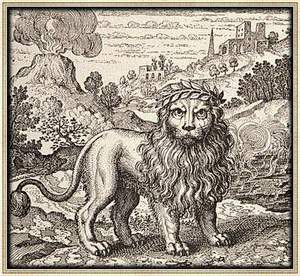
Upon visiting the zoo, I soon learned that lions sleep or rest about 20 hours a day and are mainly nocturnal. And then I realized that I had read a mistranslation - the law should be read as: "Gird yourself like a Lion in the morning to serve The Creator" (another translation is "overcome"). Lions may hang out in the shade or nap for a majority of the day, but when the king of the jungle senses danger or a possible prey, it immediately shoots up, girded for war and ready to spring to action to defend, attack, or just stare down an onlooker.
And thus I learned a powerful lesson that helped me better start my day and develop my service to 'The Creator'. One needs to be ready to go, to spring up to act, as each day there are challenges, tasks, and problems that need to be attended to - and although our inclination may be to sleep or vegge out, we must gird ourselves, overcome ourselves to do what is our mission. I really like this more than the simple teaching that it is important to get up early to daven.
One final thought - Something that I hope to draw out over the next few weeks is the connection between tefilla and self-reflection. Human beings are unique in our capacity to be self aware and reflect in a cognitive way (do animals keep blogs?). To teach and encourage young people to daven is to help them overcome a purely animalisitc behavior and discover a way to direct their lives with purpose and meaning. Thus the first halacha is an important one to set the tone for young people that both validates their nature to hide beneath the covers as the alarm clock rings but hopefully inspires them to come to school to grow, learn, and impact.
Subscribe to:
Posts (Atom)